

Semiconductor Fabrication Standards That Directly Affect Supplier Qualification
For procurement teams, Semiconductor Fabrication standards are more than technical checklists—they directly shape supplier qualification, product reliability, and long-term supply security. As global manufacturers face tighter expectations around quality, traceability, and process control, understanding which standards truly matter helps buyers reduce risk, compare vendors with confidence, and build resilient sourcing strategies across the semiconductor value chain.
This is especially true in a market where fabs, packaging houses, gas suppliers, chemical providers, and testing laboratories are interconnected. A weak link in any one of these nodes can disrupt output for 8–16 weeks, increase field failure risk, or trigger expensive requalification. For buyers sourcing power semiconductors, MEMS sensors, advanced packaging services, or high-purity process materials, supplier qualification must be anchored in measurable fabrication discipline rather than broad marketing claims.
For organizations operating in autonomous systems, industrial IoT, and high-efficiency power conversion, procurement decisions increasingly depend on whether a supplier can demonstrate compliance with internationally recognized Semiconductor Fabrication standards. In practice, that means reviewing process control, contamination management, testing capability, calibration integrity, and lot-level traceability with the same rigor applied to unit price and lead time.
Why Semiconductor Fabrication Standards Matter in Supplier Qualification
Procurement teams often inherit supplier qualification criteria from engineering or quality departments, but the commercial impact is immediate. A supplier that meets key Semiconductor Fabrication standards is usually better positioned to control yield drift, manage change notifications, and maintain consistency across 3, 6, or even 12-month sourcing cycles. For buyers, this reduces total acquisition risk, not just inspection workload.
In semiconductor manufacturing, small process deviations can produce large downstream costs. A contamination excursion measured in particles per cubic foot, a gas purity shift from sub-ppb to a higher range, or an unvalidated thermal profile in packaging can affect device leakage, reliability, and lifetime. These issues may not appear during incoming inspection, but they often surface after board assembly, burn-in, or field deployment.
Four procurement risks hidden behind weak standards control
- Inconsistent lot quality that increases qualification cycles from 2 weeks to 6 weeks.
- Poor traceability that makes root-cause analysis slow during failure investigation.
- Insufficient process validation that raises the probability of design-to-production mismatch.
- Uncontrolled change management in materials, tools, or subcontractors.
The table below highlights how specific standards categories map to practical supplier qualification decisions. It is designed for buyers who need to translate technical compliance into sourcing confidence.
The key takeaway is that Semiconductor Fabrication standards should not be reviewed as isolated certificates. Procurement should use them as evidence of operational maturity. A supplier with sound documentation but weak lab control is still risky, just as a supplier with advanced tools but poor change notification processes can create serious continuity issues.
Where standards become critical across the silicon value chain
Different sourcing categories require different qualification depth. For example, a buyer selecting 1200V SiC MOSFET supply for power conversion systems may focus heavily on reliability stress data and thermal performance consistency. A buyer sourcing high-purity electronic chemicals may prioritize impurity thresholds, packaging integrity, and laboratory traceability. In MEMS and smart sensors, calibration repeatability and environmental robustness often carry equal weight to fabrication yield.
Typical high-risk sourcing categories
- Power semiconductors using SiC or GaN, where thermal cycling and defect density strongly influence lifetime.
- Advanced packaging and testing services, where warpage, interconnect integrity, and test coverage affect final assembly yield.
- Industrial-grade MEMS sensors, where calibration drift over 12–24 months can compromise system accuracy.
- Electronic gases and wet chemicals, where purity deviations at very low thresholds can impact wafer performance.
Which Standards Buyers Should Prioritize First
Not all standards carry equal procurement value in every purchase. Buyers need a practical prioritization model. The fastest way to strengthen supplier qualification is to separate baseline management standards from application-specific fabrication and reliability standards. This creates a 2-layer framework: first verify whether the supplier runs a controlled operation, then check whether that operation is appropriate for the target device, process node, and end-use environment.
Baseline standards that support every supplier review
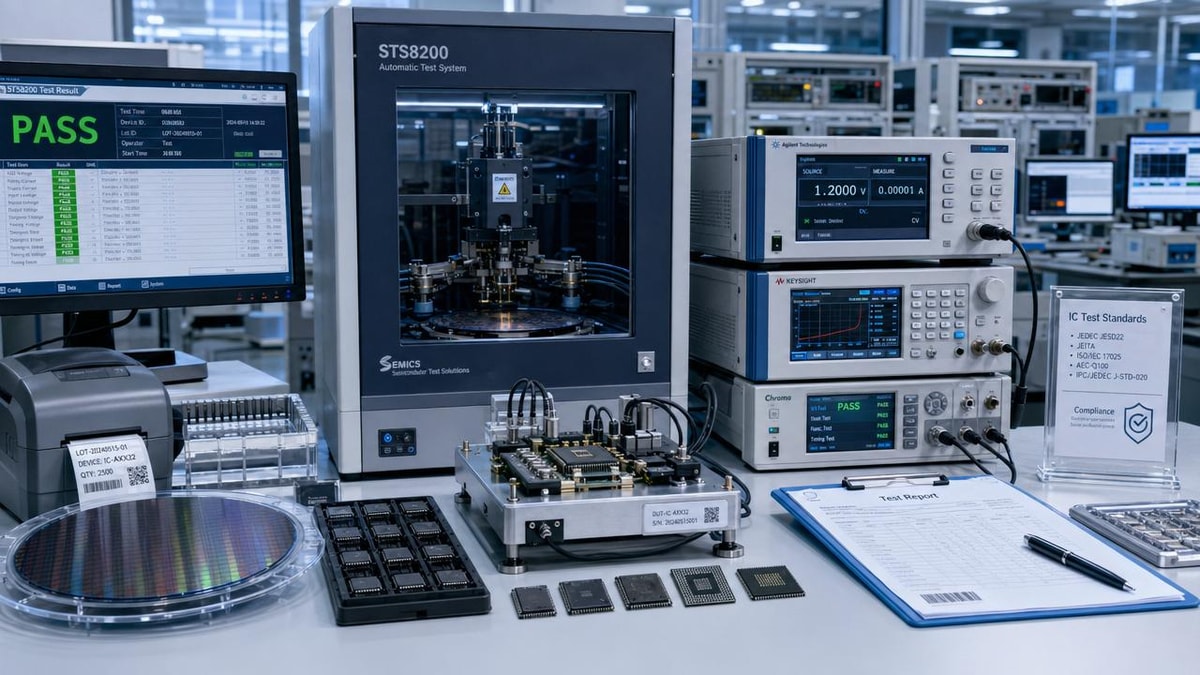
At a minimum, procurement should expect documented quality management, lot traceability, corrective action discipline, and calibrated measurement capability. In many cases, that means reviewing ISO 9001 structure, key SEMI-aligned process controls, and ISO/IEC 17025 where testing or analytical data are part of acceptance criteria. If the supplier cannot provide lot genealogy within 24–48 hours, that is usually a warning sign.
Application-specific standards that directly affect acceptance risk
For automotive, industrial, and infrastructure-grade products, reliability expectations are much higher than for short-life consumer applications. AEC-Q100 is frequently referenced for integrated circuits, while packaging and board-level stress methods may require additional customer-specific validation. Buyers should also look at process capability data, outgoing defect criteria, and environmental stress coverage across temperature bands such as -40°C to 125°C or wider when relevant.
The following matrix can help procurement teams rank standards review effort by sourcing category and supply risk exposure.
This matrix shows why one-size-fits-all qualification creates blind spots. Semiconductor Fabrication standards must be interpreted in the context of device architecture, application duty cycle, and process sensitivity. The more critical the end-use environment, the more procurement should require multi-level evidence rather than a certificate package alone.
How to Audit a Supplier Against Semiconductor Fabrication Standards
A strong supplier audit does not need to be excessively complicated, but it must be disciplined. In most B2B semiconductor sourcing programs, qualification can be structured into 5 steps over 3–8 weeks depending on product complexity and whether an on-site visit is required. Procurement should coordinate closely with quality, process engineering, and reliability teams so that commercial approval is linked to technical evidence.
A practical 5-step qualification workflow
- Collect documentation: certifications, process flow, PFMEA or equivalent risk records, lab scope, and change control procedures.
- Review fabrication controls: cleanroom discipline, contamination monitoring, SPC usage, and preventive maintenance intervals.
- Validate test credibility: calibration records, gauge repeatability, failure analysis method, and retention period for raw data.
- Check traceability depth: wafer lot, assembly lot, material batch, operator and tool history where applicable.
- Approve with conditions: define pilot lot size, acceptance thresholds, and requalification triggers for process changes.
Questions buyers should ask during an audit
Useful audit questions are specific. Ask how often key tools are recalibrated, what particle monitoring frequency is used in critical areas, how long retain samples are stored, and how quickly the supplier can issue 8D-style corrective responses. Also ask whether subcontracted steps such as plating, lid attach, final test, or gas analysis are included in the same standards framework. Hidden subcontracting is a frequent source of qualification gaps.
Common red flags during qualification
- Certificates are current, but process records are incomplete or older than 12 months.
- Lab data are presented without calibration uncertainty or method references.
- Lot traceability stops at finished goods and does not extend to wafer, gas, or chemical batch level.
- Engineering changes can be implemented in less than 30 days without customer notification.
In a resilient sourcing strategy, Semiconductor Fabrication standards are most valuable when they are translated into approval conditions. For example, a buyer may approve a supplier for pilot volume only, cap monthly release at a defined lot count, or require 2 consecutive conforming lots before full release. These controls help procurement balance supply continuity with technical caution.
From Compliance to Supply Chain Resilience
Supplier qualification should not end after the first audit. Semiconductor manufacturing environments change due to tool upgrades, material substitutions, subcontractor shifts, and capacity expansion. In fast-moving regions and mature-node growth markets, procurement should set review triggers every 6–12 months, or sooner when there is a process transfer, package change, or abnormal yield event.
How standards support long-term sourcing resilience
When buyers maintain a standards-based supplier scorecard, they gain better visibility into continuity risk. A practical scorecard can include 4 weighted areas: quality system maturity, fabrication discipline, analytical credibility, and responsiveness to corrective action. This is particularly important for categories such as advanced packaging, specialty gases, and infrastructure-grade sensors where second-source substitution may take 8–20 weeks to validate.
Recommended supplier monitoring metrics
- On-time delivery over a rolling 3-month and 6-month period.
- Lot rejection rate and recurring defect categories.
- Average turnaround time for deviation reports and corrective actions.
- Percentage of changes notified before implementation.
- Audit closure time for major and minor findings.
For institutions and industrial buyers benchmarking global semiconductor partners, the strongest suppliers are those that can align mature-node scalability with disciplined international practice. This is where a structured reference approach adds value. By comparing capabilities in power semiconductors, packaging and test, MEMS, specialty materials, and fab environment control against recognized standards, procurement teams can reduce uncertainty before a sourcing decision becomes a production dependency.
Semiconductor Fabrication standards directly influence supplier qualification because they reveal how a supplier actually controls variation, contamination, reliability, and traceability under real production conditions. For procurement professionals, that insight is essential when evaluating vendors for sovereign-grade digital infrastructure, industrial automation, and high-efficiency power systems. If you need a more structured way to benchmark semiconductor suppliers, compare qualification evidence, or build a category-specific sourcing framework, contact us to get a tailored evaluation approach and explore more semiconductor sourcing solutions.
- Power Semiconductors
- SiC MOSFET
- MEMS Sensors
- Smart Sensors
- Electronic Chemicals
- Semiconductor Fabrication
- Industrial IoT
- Autonomous Systems
- Power Conversion
- Supply Chain Resilience
- Silicon Value Chain
- Environment Control
- Reliability Standards
- Digital Infrastructure
- GaN power devices
- Semiconductor Fabrication standards
- Specialty Gases
Get weekly intelligence in your inbox.
No noise. No sponsored content. Pure intelligence.
 Apr 28, 2026When do rapid prototyping 3D printing services save real costWhen do rapid prototyping 3D printing services save real cost
 Apr 28, 2026What Can Go Wrong in Fan-out Wafer Level Pkg?What Can Go Wrong in Fan-out Wafer Level Pkg?
 Apr 28, 2026What Makes Optical LiDAR Modules Better for Autonomy?What Makes Optical LiDAR Modules Better for Autonomy?
 Apr 28, 20262026 Market Trends in Supply Chain Resilience for Fabs2026 Market Trends in Supply Chain Resilience for Fabs
 May 01, 2026Power Semiconductors Price Signals to Watch Before Your Next Sourcing CyclePower Semiconductors Price Signals to Watch Before Your Next Sourcing Cycle
 May 01, 2026Supply Chain Resilience in Electronics Manufacturing After 2026: What ChangesSupply Chain Resilience in Electronics Manufacturing After 2026: What Changes
 May 01, 2026Sensory Data for Industrial IoT: Turning Raw Signals Into Useful ActionsSensory Data for Industrial IoT: Turning Raw Signals Into Useful Actions
 May 01, 2026Industrial IoT Certification: What to Prepare Before System RolloutIndustrial IoT Certification: What to Prepare Before System Rollout
 May 01, 2026Reliability Standards for Semiconductor Manufacturing: What Gets Audited FirstReliability Standards for Semiconductor Manufacturing: What Gets Audited First
 May 01, 2026How Data Fidelity for Semiconductor Shapes Better Process DecisionsHow Data Fidelity for Semiconductor Shapes Better Process Decisions
 May 01, 2026Data Fidelity Standards: A Practical Baseline for Semiconductor TraceabilityData Fidelity Standards: A Practical Baseline for Semiconductor Traceability
 May 01, 2026IC Testing Standards: Where Compliance Failures Usually StartIC Testing Standards: Where Compliance Failures Usually Start
 May 01, 2026Semiconductor Fabrication Standards That Directly Affect Supplier QualificationSemiconductor Fabrication Standards That Directly Affect Supplier Qualification
 May 01, 2026Ultra-pure Water Skids: Avoiding Startup Delays in Semiconductor FacilitiesUltra-pure Water Skids: Avoiding Startup Delays in Semiconductor Facilities
 May 01, 2026AMC Filtration Units and the Hidden Cost of Airborne Molecular ContaminationAMC Filtration Units and the Hidden Cost of Airborne Molecular Contamination
 May 01, 2026ISO Class 1 FFU Systems: Key Checks Before Cleanroom ExpansionISO Class 1 FFU Systems: Key Checks Before Cleanroom Expansion
 May 01, 2026IC Cleaning Solvents: How Purity Levels Affect Defect ReductionIC Cleaning Solvents: How Purity Levels Affect Defect Reduction
 May 01, 2026KrF vs ArF Photoresist: Which Process Window Matters MoreKrF vs ArF Photoresist: Which Process Window Matters More
 May 01, 2026High-Purity Chemicals for Semiconductor: What to Verify Before ApprovalHigh-Purity Chemicals for Semiconductor: What to Verify Before Approval
 May 01, 2026How Electronic Chemicals for Semiconductor Impact Yield at Advanced NodesHow Electronic Chemicals for Semiconductor Impact Yield at Advanced Nodes
 May 01, 2026Sub-ppb Ultra-pure Gases: What Really Affects Process StabilitySub-ppb Ultra-pure Gases: What Really Affects Process Stability
 May 01, 2026Special Gases Supplier Selection for Sub-ppb Purity ApplicationsSpecial Gases Supplier Selection for Sub-ppb Purity Applications
 May 01, 2026Choosing Optical LiDAR Modules for Autonomous System ReliabilityChoosing Optical LiDAR Modules for Autonomous System Reliability
 May 01, 2026How High-Precision Gas Sensors Improve Trace Contamination ControlHow High-Precision Gas Sensors Improve Trace Contamination Control
 May 01, 2026Sensory Data Accuracy: Common Gaps Between Specs and Field ResultsSensory Data Accuracy: Common Gaps Between Specs and Field Results
 May 01, 2026How Smart Sensors Suppliers Support Stable Industrial MonitoringHow Smart Sensors Suppliers Support Stable Industrial Monitoring
 May 01, 2026MEMS Sensors for Medical Devices: Accuracy Risks You Should Check EarlyMEMS Sensors for Medical Devices: Accuracy Risks You Should Check Early