When do custom aluminum extrusions reduce fabrication costs?
Custom aluminum extrusions reduce fabrication costs when they remove more downstream work than they add in tooling, engineering, and profile complexity. The relevant comparison is not the price per kilogram of aluminum. It is the fully landed cost of a finished part: material yield, saw cutting, CNC time, welding, fixtures, fasteners, deburring, inspection, finishing, assembly, scrap, and the lead-time risk attached to each operation.
A custom profile is most compelling when a fabricated assembly can become one extruded component with only limited secondary operations. It is less compelling when the desired cross-section merely transfers difficult machining into a more expensive die, requires impractically tight extrusion tolerances, or will be ordered too infrequently to absorb the initial tooling cost.
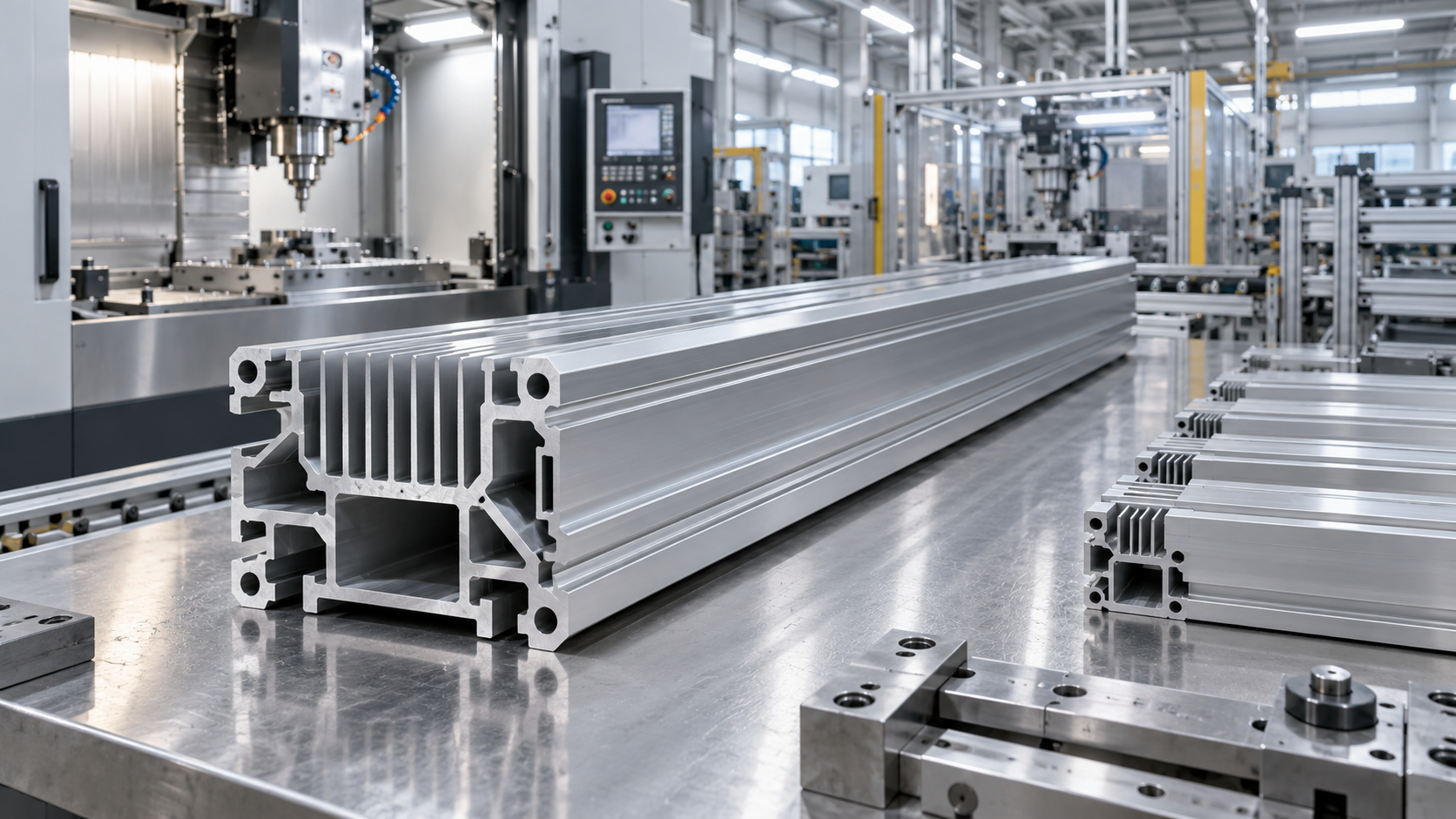
For housings, thermal frames, equipment guards, rails, enclosures, sensor structures, electrical-system supports, and semiconductor-related infrastructure, the economic case often comes from functional integration. Channels, ribs, mounting lands, cable paths, heat-dissipation fins, locating features, and closure interfaces can be created in the extrusion rather than added later through machining or assembly.
The cost question starts with the existing fabrication route
Comparing a custom extrusion with a standard angle, bar, tube, or sheet-metal assembly only by raw-material pricing leads to poor decisions. Standard shapes appear inexpensive because they avoid dedicated tooling, but they may impose a chain of recurring operations. A simple frame made from plate and bar, for example, may require multiple machining setups, welded joints, post-weld straightening, tapped holes, cleaning, and inspection. The extrusion alternative may require a die, cut-to-length service, several drilled or tapped features, and surface finishing.
The difference is especially meaningful where the original design has accumulated “fabrication workarounds.” Typical signs include:
- Several separate parts performing structural, mounting, and protective functions in the same local area;
- Long milled pockets or repeated edge machining to create channels, grooves, or stiffening features;
- Weldments that require fixtures, distortion correction, or difficult cosmetic finishing;
- Bolted or riveted subassemblies used solely because a single stock shape cannot provide the required geometry;
- High material removal from solid plate or billet;
- Repeated assembly errors involving orientation, fastener selection, or missing components.
These conditions do not automatically justify a custom die, but they identify where aluminum extrusions can change the manufacturing economics. Extrusion is a near-net-shape process: metal is placed where the part needs it, rather than removed from a larger starting section. When profile geometry replaces machining and joining, recurring cost can decline even if the extruded section costs more per meter than a commodity shape.
Where the savings actually come from
Less machining is usually the largest source of savings. A profile can incorporate longitudinal geometry that would be costly to mill: guide channels, wireways, integral flanges, snap-fit features, locating ribs, heat-sink fins, and screw-boss regions. Extrusion does not eliminate machining at ends, interfaces, or precision datums, but it can eliminate machining along the full length of the component. That distinction matters for long rails, chassis members, heat-dissipation structures, and equipment-frame elements.
Eliminating welds changes more than labor cost. Welding brings joint preparation, fixture time, consumables, skilled labor, heat distortion, cosmetic remediation, and inspection. In corrosion-sensitive or clean-environment applications, it can also introduce finishing and cleaning burdens. An integral extrusion cannot replace every weldment; closed or highly three-dimensional structures may still require joining. But where a weld exists only to combine linear elements into a constant cross-section, a profile redesign deserves examination.
Part consolidation reduces process variation. Replacing several fabricated parts with one extrusion lowers the bill-of-material count, supplier touchpoints, receiving transactions, storage locations, and assembly instructions. The financial impact can be greater than the visible labor saving where assembly failures or missing components cause rework. Consolidation also reduces tolerance stack-up: fewer interfaces mean fewer opportunities for cumulative positional error.
Material utilization can improve substantially. Machining a deep channel from plate converts a significant portion of purchased metal into chips. An extrusion creates that channel as part of the section. Aluminum scrap retains value, but scrap credit does not recover machining time, tooling wear, coolant use, handling, or the cost of buying metal that never enters the final part.
Cycle time and capacity can improve. A shorter routing may free constrained CNC, welding, or assembly capacity. This benefit should be valued carefully. It is real only when the released capacity is genuinely constrained or can be redeployed; it should not be counted as a cash saving merely because a routing sheet has fewer hours.
Tooling cost is not the only entry cost
A custom extrusion requires a dedicated die and normally involves design review before die release. Buyers often focus on the die charge because it is visible and non-recurring. The more complete launch cost includes profile engineering, sample qualification, first-article inspection, any required machining fixtures, gauges, finishing trials, packaging development, and the inventory exposure created by minimum production quantities.
The basic break-even logic is straightforward:
Break-even quantity = total non-recurring cost ÷ recurring saving per finished part.
Yet a useful calculation must use finished-part cost rather than the extrusion quotation alone. If the incumbent component costs $40 to fabricate and the redesigned extruded part costs $31 after cutting, machining, finishing, packaging, and quality costs, the recurring saving is $9. If launch costs total $18,000, the economic break-even is 2,000 parts. The calculation should then be tested against realistic demand timing, qualification risk, and the cost of holding material or finished goods.
A profile may be commercially sound at a moderate annual volume if it is used across multiple equipment variants. Conversely, a high projected volume may still be unsuitable if engineering changes are likely, because a profile die captures a specific cross-section. Revisions after tooling can require die modification or replacement, depending on the change.
Low volume does not always rule out customization. It rules out casual customization. A low-volume program can justify a die when the incumbent process relies on expensive precision machining, when a single profile replaces a complicated weldment, or when quality and delivery consequences of the current method are material. But the purchase decision should distinguish between a recurring production part and a one-off design experiment.
Design choices that preserve the cost advantage
Many extrusion savings disappear when a profile is designed as though it were a fully machined component. Extrusion has its own manufacturability rules. The best profile is not the one that places every final feature into the die; it is the one that assigns each feature to the lowest-risk, lowest-cost process while maintaining functional performance.
Wall-thickness transitions should be controlled rather than abrupt. Large differences can affect metal flow, die durability, dimensional consistency, and cooling behavior. Extremely thin walls, narrow deep channels, sharp internal corners, and complex hollow regions may be possible in some cases, but they can increase die complexity, reduce production stability, and limit the pool of capable mills.
Corner radii are another frequent source of avoidable cost. Sharp corners are rarely free in extrusion. Generous radii support metal flow and can improve die life, unless a sharp functional interface is essential. Similarly, deep narrow slots should be challenged if a standard channel or a secondary machining operation would satisfy the requirement at lower total risk.
Symmetry can help profile balance, but it is not an absolute rule. The practical issue is whether uneven geometry will create difficult metal flow or twist during extrusion and cooling. A supplier’s feasibility review should address this before a purchase order is committed, not after a die has been cut.
Hollow profiles require particular attention. They often need porthole dies, which are more complex than solid-profile dies. Longitudinal seam welds form within the extrusion process where metal streams reunite. These are not the same as external fabrication welds, but their presence can matter for pressure containment, aggressive corrosion exposure, critical fatigue loading, anodized appearance, or highly demanding leak-tightness requirements. The application must be disclosed clearly rather than assumed to be routine structural service.
Tolerances should be purchased selectively
Over-specification is one of the most common ways to turn a cost-reduction concept into an expensive extrusion. Extruded dimensions vary with profile geometry, alloy, press capability, thermal behavior, straightness requirements, and measurement method. A drawing that applies tight limits indiscriminately across the entire section may require more process control, sorting, correction, or secondary machining than the function requires.
The better practice is to identify functional datums and distinguish three categories of features: those controlled by normal extrusion capability, those that can tolerate broader variation, and those requiring post-extrusion machining. A precision bearing seat, optical reference plane, sealing land, or mating interface may need CNC finishing. There is no commercial advantage in demanding that the die produce a machined-level tolerance when a short finishing pass would provide a more reliable result.
Straightness and twist deserve the same discipline, especially for long profiles. Their required limits should be tied to assembly and functional needs: rail alignment, gasket compression, connector engagement, heat-sink contact, or enclosure closure. A vague “must be straight” note is not an inspectable requirement. It also leaves quotation comparisons unreliable because suppliers may assume different control methods.
For sensitive equipment infrastructure, dimensional requirements should be connected to the actual interface and inspection plan. This is more useful than applying generic tight tolerances to every nominal dimension. It also avoids a late-stage dispute in which a part meets the drawing but fails to assemble because critical functional datums were not defined correctly.
Alloy and temper decisions affect fabrication economics
Alloy selection should follow the component’s loading, corrosion environment, formability needs, thermal role, finishing method, and joining requirements. It should not be based solely on a familiar grade or a material’s headline strength.
Architectural and general-purpose profiles commonly use 6xxx-series alloys because they combine good extrudability with useful mechanical properties and acceptable corrosion resistance. Within that family, the selected chemistry and temper influence extrudability, surface quality, machinability, anodizing appearance, and strength. A higher-strength choice can be justified, but may create trade-offs in extrusion difficulty, lead time, availability, or finishing consistency.
Where heat transfer is a central function, the alloy decision should be evaluated alongside profile geometry and interface design. A profile with more fin area is not automatically the better thermal solution if fin spacing restricts airflow, if base thickness creates an unnecessary mass penalty, or if the actual thermal bottleneck sits at the interface between the heat source and the extrusion. For electrical enclosures or power-conversion assemblies, thermal design, surface treatment, flatness, fastening pattern, and contact materials need to be considered together.
Surface finishing also needs early definition. Mill finish, anodizing, powder coating, painting, chemical conversion, and protective films impose different requirements on surface appearance, racking locations, masking, handling, and inspection. Cosmetic anodizing requirements can be particularly restrictive because flow lines, die lines, seams, and alloy variation may become more visible after finishing. If appearance is not functionally important, the specification should not inadvertently impose architectural visual standards.
Cost comparisons must include the supply chain, not only the part
A lower unit quote can conceal higher program risk. Custom profiles often have longer launch lead times than stock shapes because die approval, extrusion scheduling, sampling, finishing, and secondary work must be coordinated. The supplier quotation should separate die lead time from production lead time and indicate whether machining, finishing, and packaging are managed in-house or through external partners.
Minimum order quantities require careful attention. Extrusion mills may operate to billet, press-run, or economical batch constraints. The resulting quantity may exceed immediate demand, creating carrying cost and change-obsolescence exposure. A procurement decision should compare this inventory commitment with the inventory required for multiple stock shapes, fabricated subcomponents, and replacement hardware under the incumbent design. The right comparison is total working capital tied to the finished solution.
Traceability requirements should be established before qualification. Where material certification is needed, purchase documents should specify the required alloy, temper, documentation type, lot traceability, and applicable test expectations. If a component enters a controlled industrial, electrical, transportation, or semiconductor-support environment, additional requirements may include cleanliness, restricted-substance declarations, surface-finish controls, packaging conditions, or process-specific inspection records. These should be defined as requirements, not assumed from the supplier’s general quality certification.
For long or high-value profiles, packaging is not a minor detail. Unsupported length, protective film selection, interleaving, moisture exposure, and transit vibration can create scratches, bowing, or finish damage that only becomes apparent at assembly. A technically acceptable extrusion can therefore become commercially unsuitable if packing and handling expectations are undefined.
When a custom profile is the wrong answer
Custom aluminum extrusions do not reduce costs when the design changes frequently, the required quantity is too small to recover launch expenses, or the part has little constant cross-sectional geometry. They are also a weak fit when most value lies in complex features at varying locations along the length, since those features still require machining or fabrication.
A standard shape may remain preferable when it is readily available, already meets the structural and interface requirements, and needs only simple cutting or drilling. It may also be safer where rapid replacement availability matters more than part optimization. In such cases, a custom profile can create unnecessary dependence on a dedicated tool and a qualified production route.
The central procurement decision is therefore not whether a custom extrusion is inherently cheaper. It is whether the profile converts expensive repeated work into stable, manufacturable geometry without creating a larger tooling, tolerance, inventory, or qualification burden. The strongest candidates are components with a long constant section, repeated demand, significant machining or welding content, and clearly defined functional interfaces. Under those conditions, a custom extrusion can reduce not only fabrication cost, but also assembly complexity and production variability.
Get weekly intelligence in your inbox.
No noise. No sponsored content. Pure intelligence.
 Apr 28, 2026When do rapid prototyping 3D printing services save real costWhen do rapid prototyping 3D printing services save real cost
 Apr 28, 2026What Can Go Wrong in Fan-out Wafer Level Pkg?What Can Go Wrong in Fan-out Wafer Level Pkg?
 Apr 28, 2026What Makes Optical LiDAR Modules Better for Autonomy?What Makes Optical LiDAR Modules Better for Autonomy?
 Apr 28, 20262026 Market Trends in Supply Chain Resilience for Fabs2026 Market Trends in Supply Chain Resilience for Fabs
 Oct 09, 2026How North American semiconductor fabs control airborne molecular contaminationHow North American semiconductor fabs control airborne molecular contamination
 Oct 08, 2026When do custom aluminum extrusions reduce fabrication costs?When do custom aluminum extrusions reduce fabrication costs?
 Oct 07, 2026How semiconductor packaging affects thermal reliability in EV power electronicsHow semiconductor packaging affects thermal reliability in EV power electronics
 Oct 06, 2026When do corrugated plastic boxes make sense for returnable shipping?When do corrugated plastic boxes make sense for returnable shipping?
 Oct 05, 2026What to verify before choosing semiconductor distributors in North AmericaWhat to verify before choosing semiconductor distributors in North America
 Oct 04, 2026How to assess a high purity materials manufacturer’s traceabilityHow to assess a high purity materials manufacturer’s traceability
 Oct 03, 2026How SiC power conversion solutions improve high-voltage invertersHow SiC power conversion solutions improve high-voltage inverters
 Oct 02, 2026When do SiC MOSFET benefits justify the higher device cost?When do SiC MOSFET benefits justify the higher device cost?
 Oct 01, 2026Which semiconductor reliability testing standards apply to power devices?Which semiconductor reliability testing standards apply to power devices?
 Sep 30, 2026How to qualify a semiconductor photoresist supplier for KrF/ArF productionHow to qualify a semiconductor photoresist supplier for KrF/ArF production
 Sep 29, 2026What image quality should portable ultrasound scanners deliver for triage?What image quality should portable ultrasound scanners deliver for triage?
 Sep 28, 2026How sub-ppb impurity control gases protect process consistencyHow sub-ppb impurity control gases protect process consistency
 Sep 27, 2026How chemical purity affects defect rates in semiconductor depositionHow chemical purity affects defect rates in semiconductor deposition
 Sep 26, 2026When do high voltage power semiconductor devices need SiC over IGBTs?When do high voltage power semiconductor devices need SiC over IGBTs?
 Sep 25, 2026How to verify quality controls at a die casting parts supplier in ChinaHow to verify quality controls at a die casting parts supplier in China
 Sep 24, 2026How to verify electronic gas purity for sub-ppb semiconductor processesHow to verify electronic gas purity for sub-ppb semiconductor processes
 Sep 23, 2026When sensory data integration improves industrial motion monitoringWhen sensory data integration improves industrial motion monitoring
 Sep 22, 2026How supply chain resilience reduces the cost of production disruptionsHow supply chain resilience reduces the cost of production disruptions
 Sep 21, 2026What autonomous systems OEMs should verify before sourcing LiDAR modulesWhat autonomous systems OEMs should verify before sourcing LiDAR modules
 Sep 20, 2026How gas purity affects defect density in epitaxial wafer growthHow gas purity affects defect density in epitaxial wafer growth
 Sep 19, 2026How substrate defects affect third-generation material device yieldHow substrate defects affect third-generation material device yield
 Sep 18, 2026How trace impurities in specialty process gases affect wafer yieldHow trace impurities in specialty process gases affect wafer yield
 Sep 17, 2026How European REACH rules affect specialty electronic chemical sourcingHow European REACH rules affect specialty electronic chemical sourcing