How European REACH rules affect specialty electronic chemical sourcing
A purchasing decision for a photoresist component, wet-process chemical, dopant source, or high-purity specialty gas can appear straightforward until the receiving site asks for REACH evidence. The material may meet a process purity specification and arrive with an apparently complete safety data sheet, yet still create a supply interruption if the EU importer, registration status, intended use, or restriction exposure has not been confirmed.
For buyers sourcing specialty electronic chemicals Europe, the practical answer is clear: REACH affects not only which substances can be purchased, but also who may place them on the EU market, what uses can be supported, what information must travel through the supply chain, and how easily an alternative source can be qualified. Compliance should therefore be assessed before technical qualification is finalized—not after production has become dependent on a material.
Why a technically acceptable chemical may still be a sourcing risk
Electronic-grade materials are often bought against narrow specifications: trace-metal limits, water content, particle count, concentration tolerance, packaging cleanliness, and batch consistency. Those controls remain essential, but they do not answer the central REACH question: is the substance or mixture legally supported for the way it will be imported and used in the European Economic Area?
The issue becomes more complex when a material crosses several commercial boundaries. A manufacturer outside the EU may sell to a distributor, the distributor may consolidate shipments, and the buyer may receive the product at a European fab, packaging facility, or laboratory. In that chain, the legal importer of record matters. The party bringing a substance, mixture, or relevant article into the EU may carry obligations that do not apply in the same way to a purely non-EU transaction.
A supplier statement saying “REACH compliant” is not enough for a procurement file. It may mean only that the supplier is aware of REACH. It may not identify the registered substance, the tonnage coverage, the legal entity holding the registration, the applicable use, or whether a restriction affects the product’s concentration, application, or downstream processing conditions.
Start with the material’s regulatory identity
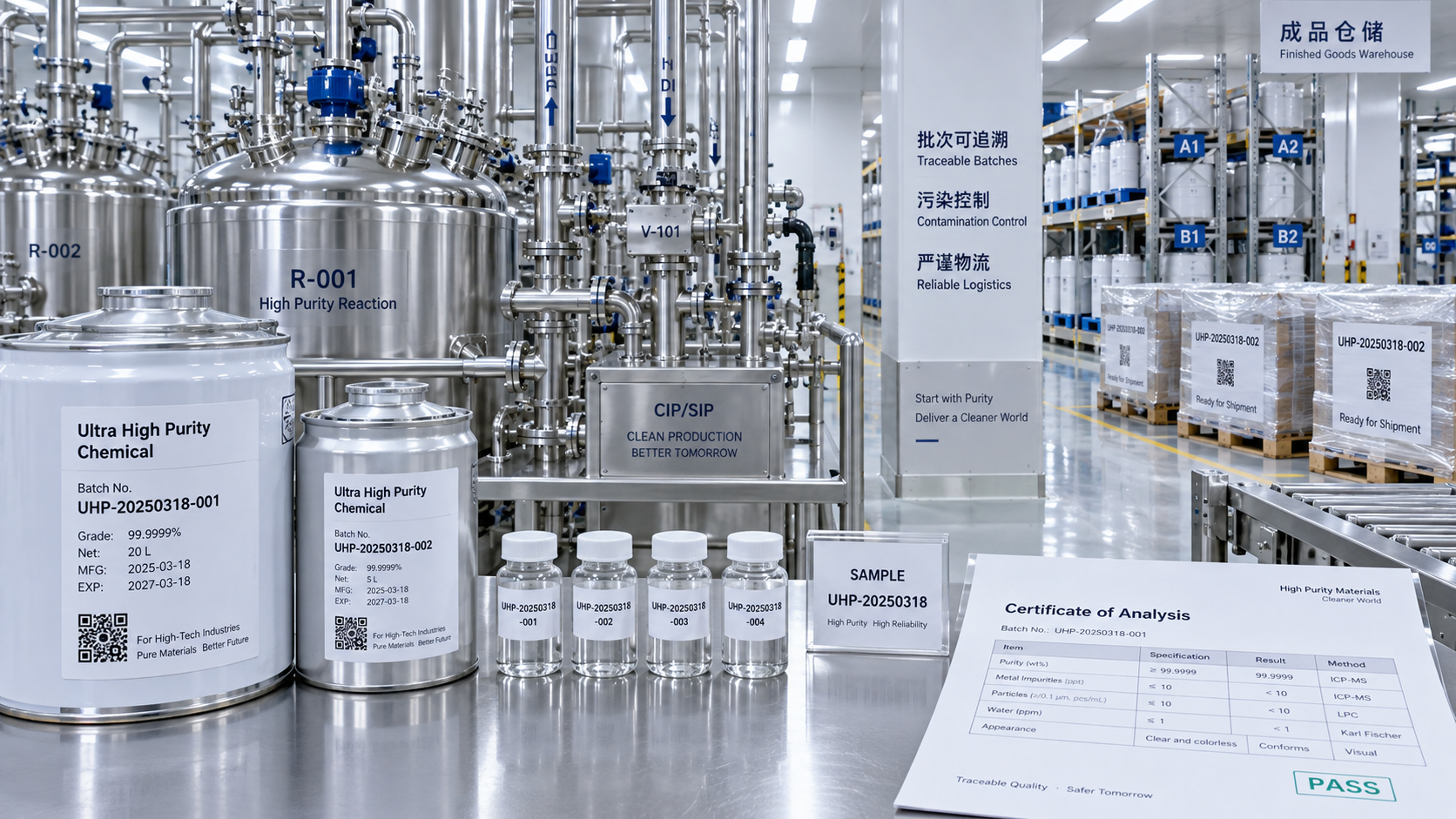
Before comparing prices or lead times, establish exactly what is being purchased. Commercial names can conceal important regulatory differences. A high-purity solvent, formulated cleaning blend, precursor solution, and compressed gas mixture may each require a different review even when they support the same process step.
Ask the supplier to identify whether the supplied item is:
- a single substance, including its chemical identity and relevant identifiers;
- a mixture, with the composition information needed for hazard and restriction review;
- a gas or gas mixture supplied in cylinders, bulk containers, or another pressure system;
- an article containing a substance that may trigger separate communication duties; or
- a formulation made specifically for an electronic manufacturing process.
This distinction is not administrative detail. REACH registration generally concerns substances, whether supplied on their own or within mixtures. A buyer purchasing a formulated stripper or etchant cannot assume that the mixture has a single “registration number.” The relevant substances must be understood, while confidential composition can be handled through appropriate supplier disclosure arrangements where necessary.
For electronic chemicals, purity changes can also complicate identity management. Trace impurities may be technically decisive for yield or reliability, but not every impurity changes the substance identity for REACH purposes. Procurement should avoid making that determination internally from a certificate of analysis alone. The supplier should explain the regulatory identity and confirm whether the grade being sold is covered by the stated compliance position.
Registration: determine who carries the obligation
REACH places registration responsibilities on EU manufacturers and importers of substances at or above the applicable annual tonnage threshold. A non-EU producer cannot itself be the registrant in the ordinary sense, but it may appoint an EU-based Only Representative to take on registration duties for covered imports. That arrangement can materially reduce the obligations of individual EU importers—but only when it is valid, current, and demonstrably covers the imported substance and supply chain.
During supplier qualification, obtain a direct answer to four points:
- Who is the EU legal entity responsible for the REACH position?
- Is the material supplied from EU manufacture, through an Only Representative arrangement, or through an importer that assumes the duty?
- Does the coverage apply to the actual substance identity and anticipated import volume?
- Can the supplier provide evidence appropriate to the transaction without disclosing protected commercial information unnecessarily?
The buyer does not need to demand every confidential registration detail. However, the purchasing organization does need enough documentary assurance to understand whether it is becoming an importer with its own obligations. This is especially important when buying directly from a manufacturer outside the EU, using a freight-forwarding arrangement, or changing Incoterms. A logistics change can shift practical and legal responsibility even though the product specification has not changed.
Do not treat a registration number as a universal approval mark. Registration does not automatically confirm that every downstream use is supported, that every hazard is acceptable, or that a restriction does not apply. It is one element of a larger compliance assessment.
Use matters as much as substance identity
In semiconductor and sensor manufacturing, the same chemical can be used in a closed delivery system, an open wet bench, a laboratory development process, a cleaning operation, or a maintenance procedure. Exposure conditions, concentration, temperature, frequency, and risk-management measures may differ sharply among those uses.
Where an extended safety data sheet and exposure scenarios are provided, procurement should ensure that environmental health and safety personnel and process owners review whether the intended operation falls within the supplier’s described conditions of use. A document can be current and still be unsuitable for a planned application if the use, scale, or controls differ from those covered.
For example, a specialty solvent may be sourced for limited analytical use and later considered for recurring production cleaning. The commercial volume, handling pattern, ventilation requirements, waste stream, and worker exposure controls may all change. The sourcing team should flag that transition before issuing a blanket purchase agreement. Similarly, a precursor supplied for a contained deposition tool should not be assumed suitable for manual transfer or open-container development work.
Questions to resolve with technical and EHS teams
- Is the material used as supplied, diluted, blended, reclaimed, or transferred into another container?
- Will the process operate in a closed system, enclosed tool, ventilated bench, or open handling environment?
- Does the planned use match the supplier’s identified use and recommended controls?
- Will process residues, scrubber media, spent solvents, or contaminated packaging create a separate waste-management concern?
- Is the material intended for development work only, or will it become a qualified production input?
These are not questions to push entirely onto the supplier. The supplier can describe the material and its supported use conditions; the site must accurately describe its own process and controls. A good procurement record captures both sides of that exchange.
Restrictions and authorization can change the commercial decision
REACH includes mechanisms that can limit or condition the use of certain substances. A material may face a restriction under Annex XVII, or it may involve a substance included on the Candidate List of substances of very high concern. Some substances are subject to authorization requirements under Annex XIV. The relevance depends on the substance, its concentration, its use, and the legal status of the supplied product.
The right procurement response is not to reject every material associated with a hazardous classification or a Candidate List entry. Many specialty electronic chemicals are inherently hazardous because of the performance required in controlled industrial processes. The decision should instead distinguish among hazards, legal restrictions, permitted uses, exposure controls, and substitution feasibility.
Restrictions can be easy to miss when a purchasing specification focuses only on purity and packaging. A buyer may approve a substitute based on equivalent assay and contaminant performance, only to find that its composition changes the restriction analysis. Any formulation change, alternate solvent, stabilizer, inhibitor, or carrier gas should trigger a fresh regulatory review rather than being handled as a simple technical equivalency.
Safety data sheets are operating documents, not filing attachments
An up-to-date safety data sheet is a core procurement requirement, but it should be checked for relevance as well as availability. Confirm the supplier, product identifier, revision date, hazard classification, composition disclosure appropriate to the product, transport information, handling guidance, storage conditions, and emergency measures. For high-purity chemicals and gases, packaging and delivery information may also affect whether site controls are adequate.
A mismatch between the purchase description and the safety data sheet deserves immediate attention. Common examples include a supplier quotation using a trade name while the safety data sheet identifies a broader family of formulations, a stated electronic grade not appearing in the document, or a gas blend concentration that differs from the purchasing specification. These gaps do not prove noncompliance, but they make it difficult to demonstrate that the reviewed document applies to the material actually received.
Version control matters after qualification. Suppliers may revise classifications, update composition ranges, change an Only Representative arrangement, alter a manufacturing location, or replace a component in a blend. A sourcing contract should define how regulatory and material changes are communicated before shipment where practicable. The receiving process should also retain lot-level links among purchase order, certificate of analysis, safety data sheet revision, and compliance declaration.
Build REACH review into dual sourcing, not after it
Second-source qualification is where REACH differences often become visible. Two materials can perform similarly in an initial lab trial but have different regulatory identities, importer structures, supply-chain documentation, or use conditions. A substitute that appears cheaper may require new controls, new documentation review, or a different import arrangement. Its real landed cost includes those qualification and continuity burdens.
For critical electronic materials, use separate gates for technical suitability and regulatory readiness. Technical teams can assess process compatibility, contamination risk, tool behavior, and reliability impact. Procurement can verify commercial terms, origin, supply resilience, and documentation. EHS or regulatory staff can review use conditions and restriction exposure. None of these approvals should silently stand in for the others.
A practical supplier file for specialty electronic chemicals Europe should include the current safety data sheet, an explicit REACH status statement, the identity of the responsible EU entity or Only Representative where applicable, confirmation of intended-use support, relevant Candidate List or restriction declarations, and a defined notification route for material or regulatory changes. For gases and highly hazardous precursors, add packaging, cylinder ownership, valve compatibility, emergency response, return logistics, and residual-material responsibilities.
Commercial terms that protect continuity
REACH-related supply risk is often contractual before it becomes operational. A purchase agreement can require the supplier to provide current compliance information, notify the buyer of changes that may affect lawful supply or intended use, and cooperate with reasonable traceability requests. The wording should not demand impossible guarantees, such as a promise that no regulation will ever change. It should require timely disclosure of known changes and a disciplined process for evaluating their effect.
Buyers should also clarify who bears responsibility when a shipment cannot be placed on the market because documentation is incomplete or the import arrangement differs from what was represented. This is particularly relevant for small-volume, high-value materials where expedited shipments, sample orders, or direct deliveries are common. A sample delivered under one route does not necessarily establish a compliant model for recurring production supply.
When documentation is incomplete, the safest commercial choice is usually not to rely on verbal assurance or postpone the review until goods are in transit. Resolve the legal entity, substance identity, and intended-use questions before issuing a production release. For materials already embedded in a qualified process, maintain an alternative-source review path early enough to avoid a rushed substitution after a regulatory or supplier change.
Questions procurement teams often raise
Does REACH apply only to hazardous electronic chemicals?
No. REACH obligations are not limited to substances labeled hazardous. Hazard classification, registration, restrictions, authorization, and communication duties are related but separate matters. A non-hazardous classification does not remove the need to understand the substance’s supply-chain status.
Can an EU distributor handle everything?
An EU distributor may simplify purchasing, but its role should be verified. Distribution does not automatically mean the distributor holds a registration or that every intended use has been evaluated. Ask how the material enters the EU market and which entity supports the REACH position.
Is a supplier declaration enough for a low-volume specialty material?
Low volume may affect registration thresholds, but it does not eliminate the need for accurate identity, safety, restriction, and import-role information. The evidence needed should be proportionate to risk, yet it must be specific enough to support the actual transaction and use.
Get weekly intelligence in your inbox.
No noise. No sponsored content. Pure intelligence.
 Apr 28, 2026When do rapid prototyping 3D printing services save real costWhen do rapid prototyping 3D printing services save real cost
 Apr 28, 2026What Can Go Wrong in Fan-out Wafer Level Pkg?What Can Go Wrong in Fan-out Wafer Level Pkg?
 Apr 28, 2026What Makes Optical LiDAR Modules Better for Autonomy?What Makes Optical LiDAR Modules Better for Autonomy?
 Apr 28, 20262026 Market Trends in Supply Chain Resilience for Fabs2026 Market Trends in Supply Chain Resilience for Fabs
 Oct 09, 2026How North American semiconductor fabs control airborne molecular contaminationHow North American semiconductor fabs control airborne molecular contamination
 Oct 08, 2026When do custom aluminum extrusions reduce fabrication costs?When do custom aluminum extrusions reduce fabrication costs?
 Oct 07, 2026How semiconductor packaging affects thermal reliability in EV power electronicsHow semiconductor packaging affects thermal reliability in EV power electronics
 Oct 06, 2026When do corrugated plastic boxes make sense for returnable shipping?When do corrugated plastic boxes make sense for returnable shipping?
 Oct 05, 2026What to verify before choosing semiconductor distributors in North AmericaWhat to verify before choosing semiconductor distributors in North America
 Oct 04, 2026How to assess a high purity materials manufacturer’s traceabilityHow to assess a high purity materials manufacturer’s traceability
 Oct 03, 2026How SiC power conversion solutions improve high-voltage invertersHow SiC power conversion solutions improve high-voltage inverters
 Oct 02, 2026When do SiC MOSFET benefits justify the higher device cost?When do SiC MOSFET benefits justify the higher device cost?
 Oct 01, 2026Which semiconductor reliability testing standards apply to power devices?Which semiconductor reliability testing standards apply to power devices?
 Sep 30, 2026How to qualify a semiconductor photoresist supplier for KrF/ArF productionHow to qualify a semiconductor photoresist supplier for KrF/ArF production
 Sep 29, 2026What image quality should portable ultrasound scanners deliver for triage?What image quality should portable ultrasound scanners deliver for triage?
 Sep 28, 2026How sub-ppb impurity control gases protect process consistencyHow sub-ppb impurity control gases protect process consistency
 Sep 27, 2026How chemical purity affects defect rates in semiconductor depositionHow chemical purity affects defect rates in semiconductor deposition
 Sep 26, 2026When do high voltage power semiconductor devices need SiC over IGBTs?When do high voltage power semiconductor devices need SiC over IGBTs?
 Sep 25, 2026How to verify quality controls at a die casting parts supplier in ChinaHow to verify quality controls at a die casting parts supplier in China
 Sep 24, 2026How to verify electronic gas purity for sub-ppb semiconductor processesHow to verify electronic gas purity for sub-ppb semiconductor processes
 Sep 23, 2026When sensory data integration improves industrial motion monitoringWhen sensory data integration improves industrial motion monitoring
 Sep 22, 2026How supply chain resilience reduces the cost of production disruptionsHow supply chain resilience reduces the cost of production disruptions
 Sep 21, 2026What autonomous systems OEMs should verify before sourcing LiDAR modulesWhat autonomous systems OEMs should verify before sourcing LiDAR modules
 Sep 20, 2026How gas purity affects defect density in epitaxial wafer growthHow gas purity affects defect density in epitaxial wafer growth
 Sep 19, 2026How substrate defects affect third-generation material device yieldHow substrate defects affect third-generation material device yield
 Sep 18, 2026How trace impurities in specialty process gases affect wafer yieldHow trace impurities in specialty process gases affect wafer yield
 Sep 17, 2026How European REACH rules affect specialty electronic chemical sourcingHow European REACH rules affect specialty electronic chemical sourcing