

Electronic Chemicals Standards: What to Verify Before Approval
Before approving materials for semiconductor production, quality and safety teams must verify far more than a supplier’s specification sheet. The core search intent behind Electronic Chemicals standards is practical: buyers, quality managers, and EHS leaders want a clear approval framework to determine whether a chemical is truly suitable for fab use, safe to handle, traceable across batches, and compliant with relevant purity, packaging, and transport requirements.
For quality control and safety professionals, the biggest concern is not the definition of a standard but the risk of approving the wrong material. A chemical can meet a nominal grade yet still introduce metal contamination, particles, outgassing issues, packaging failures, or logistics nonconformities that reduce yield, damage tools, or create workplace hazards. What matters most is knowing what to verify before approval, what evidence to request, and which warning signs justify rejection or deeper audit.
The most valuable content for this audience is therefore a structured decision guide: which specifications are critical, how to review certificates and test reports, how to assess supplier capability, which standards and controls affect semiconductor operations, and how quality and safety teams should align before sign-off. This article focuses on those operational questions and keeps general background to a minimum.
What quality and safety teams are really approving
In semiconductor environments, approving an electronic chemical is not just a purchasing decision. It is a process qualification decision with direct implications for yield, equipment uptime, product reliability, worker protection, and downstream customer compliance. That is why Electronic Chemicals standards should be treated as a baseline control system, not as marketing language.
Depending on the process, the approved material may be a wet chemical, solvent, acid, base, cleaning agent, photo-related support chemical, dopant precursor, or high-purity specialty material used in packaging, testing, sensing, or environmental control systems. Each category carries different technical and safety risks, but the approval logic is similar: verify the material itself, verify the package, verify the supplier, and verify the movement of the product through storage and transport.
For most quality and safety teams, the fastest way to frame the task is this question: if this chemical is released into production tomorrow, what could go wrong that would not be visible on a basic data sheet? The answer usually includes trace metals, particles, organic impurities, moisture variation, mislabeled containers, unstable packaging, incomplete lot traceability, transport exposure, and weak change control. Those are the areas that deserve the most attention before approval.
Start with fit-for-use, not just headline purity
One of the most common approval mistakes is over-relying on a single purity percentage. A material labeled as 99.99% pure may still be unsuitable for a critical semiconductor process if the remaining impurity profile includes unacceptable metal ions, chlorides, sulfates, organics, or particles. In other words, total purity is useful, but impurity type and limit matter more.
Quality teams should first confirm whether the chemical grade matches the actual process sensitivity. A cleaning step on mature-node equipment, an advanced packaging line, and a MEMS sensor production cell may all require different impurity thresholds. Approval should therefore begin with an internal fit-for-use review: process step, equipment interface, allowable contaminants, contact materials, temperature conditions, and expected impact on device performance.
Ask the supplier for a full technical specification that goes beyond assay. The minimum useful package usually includes impurity limits by category, analytical methods, lot release criteria, shelf-life conditions, recommended storage range, and container compatibility information. If the supplier only provides a sales data sheet with broad claims such as “semiconductor grade,” that is not enough for approval.
For critical applications, compare the supplier’s specification limits against your own process control thresholds rather than against industry averages alone. A chemical may conform to a general market grade but still be too variable for your line. Internal process tolerance should always override generic labeling.
Verify contamination control at the level that affects yield
For semiconductor applications, contamination is usually the deciding factor. The approval review should separate contamination into four practical groups: metallic contamination, particulate contamination, organic contamination, and moisture or dissolved gas variation where relevant. Each one can produce different failure modes, from wafer defects and corrosion to adhesion problems and electrical instability.
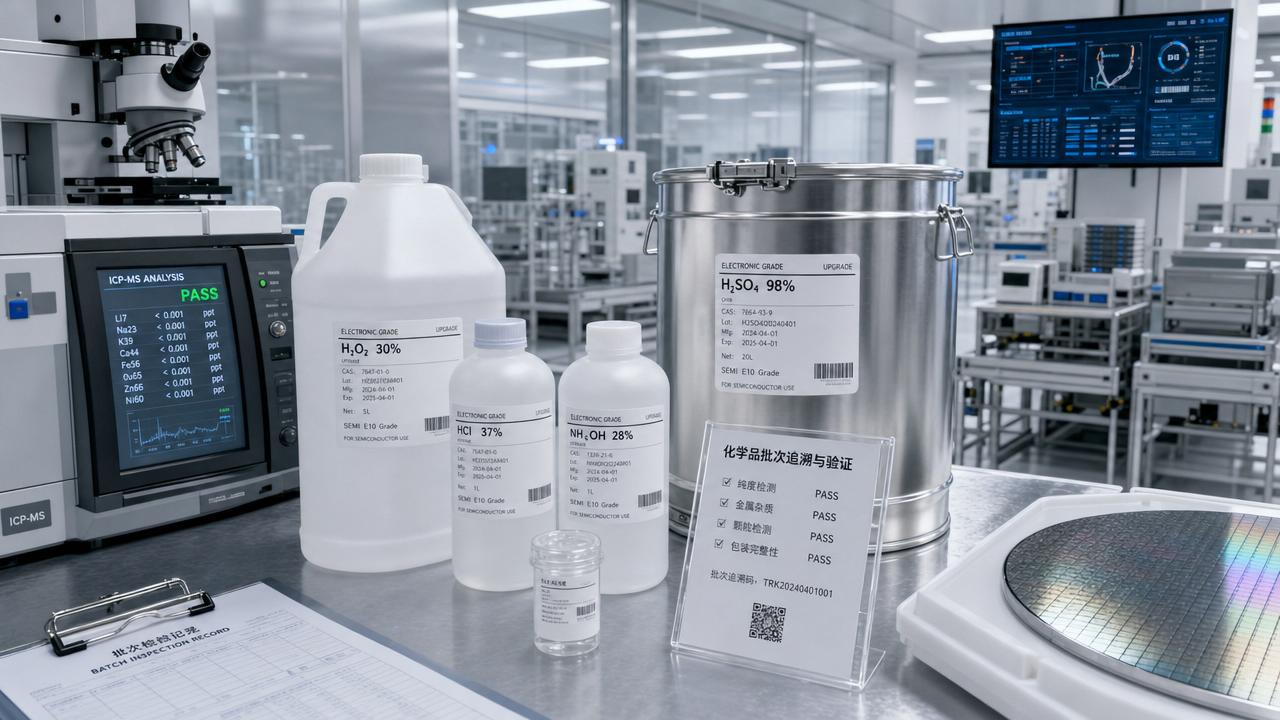
Trace metals often receive the most attention because they can poison process performance or affect electrical characteristics. Review the certificate of analysis for metal limits that are appropriate to the use case, and do not accept aggregated statements like “meets ultra-trace standard” without analyte-specific values. It is also worth checking whether the supplier uses validated analytical methods with suitable detection limits, such as ICP-MS or equivalent methods fit for the impurity range being claimed.
Particles are equally critical, especially for wet processes, precision cleaning, and sensor-related fabrication. Verify whether the supplier controls particle counts by size band and whether filtration and filling operations are performed in controlled environments. A material can be chemically pure and still be operationally risky if particle control is weak during packaging.
Organic contamination and residual solvents may affect photo-sensitive processes, surface preparation, or packaging reliability. If the chemical will contact sensitive surfaces or high-reliability assemblies, request data on total organic carbon, residual contaminants, and process-relevant organics. For some chemicals, moisture content is another key release criterion, particularly where hydrolysis, corrosion, or reaction instability is possible.
The practical question is simple: which contaminants actually threaten your process window? Approval becomes faster and more reliable when the review is tied to real failure mechanisms rather than generic chemical descriptors.
Do not approve without strong lot traceability and change control
A chemical that passes incoming inspection once is not automatically a stable approved material. Semiconductor operations depend on repeatability, which means lot traceability and formal change control are essential parts of Electronic Chemicals standards review. If a supplier cannot show disciplined control over raw materials, production batches, and packaging lots, future deviations may arrive without warning.
At minimum, each delivered lot should be traceable to production date, batch number, manufacturing site, test release data, packaging line, and where applicable the source lots of key feedstocks. The certificate of analysis should clearly match the shipped lot and include revision-controlled specifications. In regulated or highly controlled environments, digital traceability and retention periods for records should also be reviewed.
Change control is just as important. Ask whether the supplier has a formal notification process for changes to raw materials, process parameters, analytical methods, filling lines, containers, liners, labels, storage conditions, and transport arrangements. Even minor changes can introduce new contamination pathways or alter stability. Approval should define what type of changes require prior customer notification, requalification, or sample resubmission.
If the supplier’s response to change management is vague or informal, that is a meaningful risk signal. Quality teams should not rely on goodwill where documented control is required.
Assess packaging integrity as part of product quality
Many approval failures happen because teams evaluate the chemical but under-evaluate the packaging. In semiconductor supply chains, packaging is part of the product system. Poor container materials, ineffective seals, contamination-prone dispensing interfaces, and weak cleaning of reusable vessels can all compromise an otherwise acceptable chemical.
Review the compatibility of the container with the chemical over the full storage period, including possible leachables, moisture ingress, permeation, and particle shedding. For high-purity products, ask whether the packaging material and closure system are selected specifically for electronic-grade use rather than adapted from general industrial chemical packaging.
It is also important to understand the filling environment and post-fill controls. Was the material filtered at final fill? Are closures torque-controlled? Are containers double-bagged where needed? Is there tamper evidence? How are cleaned vessels verified before reuse? For drums, bottles, or bulk delivery systems used in fab environments, the cleanliness of valves, connectors, and transfer hardware can matter as much as the liquid itself.
Labels should support both safety and traceability. That means clear identity, lot number, hazard communication, storage conditions, expiry or retest date, and where needed transport classification. Approval should confirm that labeling is durable and legible through storage and use conditions.
Review supplier quality systems, not just test results
A strong certificate of analysis is helpful, but it is only one output of a supplier’s quality system. Before approval, teams should evaluate whether the manufacturer’s management system can consistently produce the same result over time. This is where supplier qualification, audits, and document review become essential.
Relevant evidence may include ISO 9001 certification, laboratory competence aligned with ISO/IEC 17025 for critical testing, controlled manufacturing procedures, calibration records, environmental monitoring, deviation handling, CAPA procedures, and retention sample practices. In some cases, conformance to SEMI-related expectations or customer-specific semiconductor quality controls may also be appropriate, even where no single universal electronic chemical standard applies to every product type.
Look closely at how the supplier handles out-of-specification results, investigations, and complaint feedback. A mature supplier can explain not only what happened, but how root cause was identified and how recurrence was prevented. That level of discipline often predicts long-term reliability better than a polished brochure.
For safety managers, supplier capability also includes hazard communication quality. Safety data sheets should be current, jurisdictionally correct, and aligned with the exact product being supplied. Emergency handling guidance, incompatibility information, and exposure controls should be specific enough to support your site risk assessment, not copied from a generic template.
Confirm transport, storage, and handling compliance before release
Even a well-made chemical can fail in the supply chain. That is why approval should extend beyond manufacturing quality into logistics control. Electronic Chemicals standards in practice include maintaining product integrity during storage, transit, receipt, and internal handling.
Review the transport classification, packaging group, temperature control requirements, segregation rules, and applicable dangerous goods documentation. Confirm whether the product has sensitivity to freezing, overheating, light exposure, or transit duration. If shelf life is short or stability is condition-dependent, logistics planning must be part of the approval decision.
At the receiving site, verify whether current infrastructure is suitable: chemical storage cabinets or rooms, ventilation, spill containment, transfer systems, grounding where relevant, personal protective equipment, and emergency response procedures. A material may be acceptable in theory but unsuitable for a site that lacks the correct controls for storage or dispensing.
For safety teams, this is where operational readiness matters. Approval should not be granted if worker training, exposure controls, waste handling pathways, and incident response plans are incomplete. Quality approval and EHS approval should be linked, not sequenced in isolation.
Which documents should be mandatory before approval?
For most organizations, a practical approval file should include at least the following: technical data sheet, safety data sheet, certificate of analysis template, representative lot test report, product specification with impurity limits, packaging specification, shelf-life and storage guidance, transport classification details, supplier quality certifications, and change notification policy.
For higher-risk or higher-value process chemicals, add audit reports, analytical method summaries, contamination control procedures, compatibility data, extractables or leachables information where relevant, and a signed quality agreement. If the material supports critical fab steps, pilot lot evaluation and internal trial results should also be part of the final approval record.
The goal is not to collect paperwork for its own sake. The goal is to ensure that every key approval question can be answered with evidence: what the product is, how clean it is, how stable it is, how it is packaged, how it is traced, how it is changed, how it is transported, and how it is safely used.
Red flags that justify rejection or deeper review
Several warning signs should immediately slow down approval. These include missing analyte-level impurity data, inconsistent lot documentation, supplier reluctance to disclose test methods, outdated or generic safety data sheets, no formal change notification process, unexplained specification revisions, weak packaging descriptions, and inability to support traceability from lot to shipment.
Other red flags are more subtle but equally serious: unusually broad specification ranges, repeated “typical value” language instead of guaranteed limits, lack of retention sample practice, poor response to audit questions, and no evidence that filling or packaging is performed under controlled cleanliness conditions. In logistics, unexplained relabeling, broken tamper evidence, or frequent shelf-life erosion during transit should trigger corrective action.
Approval teams should also be cautious when a supplier claims compliance with Electronic Chemicals standards in general terms without naming the actual standards, internal controls, or validated test basis behind the claim. In high-purity environments, unsupported claims are not controls.
A practical approval workflow for quality and safety teams
A useful workflow begins with process classification. Define the intended use, criticality, contamination sensitivity, and hazard profile. Then perform document review to confirm specification completeness, safety information, and traceability capability. If the material passes paper review, move to supplier qualification and, where warranted, audit or detailed questionnaire.
Next comes technical verification. Review representative lot data, compare impurity limits to internal thresholds, assess packaging compatibility, and confirm logistics conditions. For critical materials, conduct an incoming inspection plan and a controlled production trial. Capture all deviations, test outcomes, and user feedback from operations or engineering.
Finally, complete cross-functional sign-off. Quality, process engineering, procurement, and EHS should all confirm that the chemical is suitable, controllable, and supportable at site level. Approval should include status conditions such as approved for specific use only, approved with enhanced incoming inspection, or approved pending supplier audit closure.
This structured approach reduces the chance that a chemical is approved on price or urgency alone. It also creates a documented basis for defending the decision if failures occur later.
Conclusion: approval should prove control, not just product availability
For semiconductor manufacturing and sensory infrastructure operations, Electronic Chemicals standards are not a checklist to satisfy procurement—they are a control framework for protecting yield, reliability, and safety. Before approval, teams should verify fit-for-use specifications, contamination limits, lot traceability, change control, packaging integrity, supplier quality systems, and transport compliance. Those are the points where real production risks usually hide.
The best approval decisions come from cross-functional discipline. When quality control and safety management review the same material through both process and hazard lenses, they are more likely to catch issues before they reach the fab floor. In practice, the right question is not whether the supplier says the product is electronic grade. It is whether the evidence shows the material can perform consistently, arrive intact, remain traceable, and be handled safely under your operating conditions.
If that evidence is complete and credible, approval is justified. If it is incomplete, approval should wait—because in semiconductor environments, one weak chemical control can become a very expensive failure.
Get weekly intelligence in your inbox.
No noise. No sponsored content. Pure intelligence.
 Apr 28, 2026When do rapid prototyping 3D printing services save real costWhen do rapid prototyping 3D printing services save real cost
 Apr 28, 2026What Can Go Wrong in Fan-out Wafer Level Pkg?What Can Go Wrong in Fan-out Wafer Level Pkg?
 Apr 28, 2026What Makes Optical LiDAR Modules Better for Autonomy?What Makes Optical LiDAR Modules Better for Autonomy?
 Apr 28, 20262026 Market Trends in Supply Chain Resilience for Fabs2026 Market Trends in Supply Chain Resilience for Fabs
 May 07, 2026EV Charging Stations Commercial Installation: Hidden Costs Before Break GroundEV Charging Stations Commercial Installation: Hidden Costs Before Break Ground
 May 07, 2026ESS Energy Storage Lithium Ion Batteries: Safety Points That Cannot Be MissedESS Energy Storage Lithium Ion Batteries: Safety Points That Cannot Be Missed
 May 07, 2026Lithium Ion Batteries Manufacturer in China: What to Check Before ShortlistingLithium Ion Batteries Manufacturer in China: What to Check Before Shortlisting
 May 07, 2026Photovoltaic Modules for Residential Use: Better Payback Starts with SizingPhotovoltaic Modules for Residential Use: Better Payback Starts with Sizing
 May 07, 2026Solar Panels Wholesale USA: What Impacts Bulk Pricing MostSolar Panels Wholesale USA: What Impacts Bulk Pricing Most
 May 07, 2026Steel Forging High Strength Components: How to Compare Lifecycle ValueSteel Forging High Strength Components: How to Compare Lifecycle Value
 May 07, 2026Hybrid Inverters Cost-Effective Solutions: Where Savings Are Often OverstatedHybrid Inverters Cost-Effective Solutions: Where Savings Are Often Overstated
 May 07, 2026EV Charging Stations Quick Installation Guide for Low-Downtime RolloutsEV Charging Stations Quick Installation Guide for Low-Downtime Rollouts
 May 07, 2026Sensory Data for Industrial IoT: When More Data Stops Adding ValueSensory Data for Industrial IoT: When More Data Stops Adding Value
 May 07, 2026High-Purity Chemicals for Semiconductor: How Contamination Risk Is ReducedHigh-Purity Chemicals for Semiconductor: How Contamination Risk Is Reduced
 May 07, 2026Hybrid Inverters for Solar Energy Systems: Which Features Pay Off FirstHybrid Inverters for Solar Energy Systems: Which Features Pay Off First
 May 07, 2026Power Semiconductors Price in 2026: What Buyers Should Watch NowPower Semiconductors Price in 2026: What Buyers Should Watch Now
 May 07, 2026Smart Sensors Supplier Selection: What Affects Long-Term Field ReliabilitySmart Sensors Supplier Selection: What Affects Long-Term Field Reliability
 May 07, 20263D Chiplet Design Guide for Teams Balancing Bandwidth and Yield3D Chiplet Design Guide for Teams Balancing Bandwidth and Yield
 May 07, 2026Smart Sensors for IoT Applications: Choosing for Accuracy vs Battery LifeSmart Sensors for IoT Applications: Choosing for Accuracy vs Battery Life
 May 07, 2026Electronic Chemicals Standards: What to Verify Before ApprovalElectronic Chemicals Standards: What to Verify Before Approval
 May 07, 2026Semiconductor Standards Compliance Mistakes That Delay Market AccessSemiconductor Standards Compliance Mistakes That Delay Market Access
 May 07, 2026Digital Infrastructure for 5G Networks: Build Now or Phase DeploymentDigital Infrastructure for 5G Networks: Build Now or Phase Deployment
 May 07, 2026Sovereign Digital Infrastructure Solutions and the Real Cost of ControlSovereign Digital Infrastructure Solutions and the Real Cost of Control
 May 07, 2026Data Fidelity for Semiconductor: Common Gaps Between Tools and ReportsData Fidelity for Semiconductor: Common Gaps Between Tools and Reports
 May 07, 2026Reliability Standards for Semiconductor Manufacturing That Matter in AuditsReliability Standards for Semiconductor Manufacturing That Matter in Audits
 May 07, 2026Digital Infrastructure for Smart Cities: What Makes Projects ScalableDigital Infrastructure for Smart Cities: What Makes Projects Scalable
 May 07, 2026How to Evaluate a Semiconductor Fabrication Supplier Beyond CapacityHow to Evaluate a Semiconductor Fabrication Supplier Beyond Capacity